Growth, Physiological and Biochemical Effects of Atrazine on Foxtail Millet Genotypes
Konda Sravan Simha Reddy
Molecular Genetics and Functional Genomics Laboratory, Department of Biotechnology, School of Life Sciences, Yogi Vemana University, Kadapa - 516005, India.
Chavan Syam Raj Naik
ANGRAU-Regional Agricultural Research Station, Acharya N.G. Ranga Agricultural University, Lam, Guntur– 522034, India.
CVCM Reddy
ANGRAU-Regional Agricultural Research Station, Acharya N.G. Ranga Agricultural University, Lam, Guntur– 522034, India.
Akila Chandra Sekhar *
Molecular Genetics and Functional Genomics Laboratory, Department of Biotechnology, School of Life Sciences, Yogi Vemana University, Kadapa - 516005, India.
*Author to whom correspondence should be addressed.
Abstract
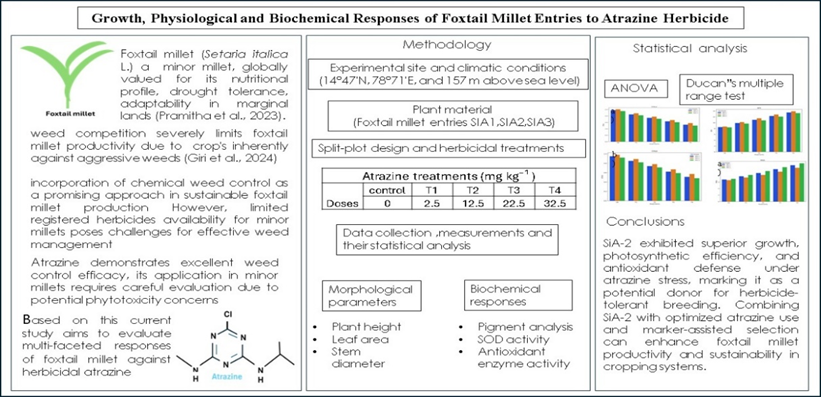
Aim: Weeds, a major constraint in foxtail millet cultivation, with manual weeding remains the most commonly adopted management practice. However, rising labor costs necessitate the search for safe chemical weed management strategies. This study evaluates agronomic, physiological, and biochemical responses of three foxtail millet genotypes (SiA‑1, SiA‑2 and SiA‑3) to atrazine herbicide under field conditions during 2022-2025.
Study Design: The experiment was laid out in a split-plot design with three replications. Main plots were assigned to foxtail millet genotypes, while sub-plots received atrazine treatments.
Methodology: The foxtail millet genotypes SiA‑1, SiA‑2 and SiA‑3 were utilized for the study. The treatments comprised five doses with concentration: 0 (control, CK), 2.5 (T1), 12.5 (T2), 22.5 (T3), and 32.5 (T4) mg kg⁻¹. Growth traits, photosynthetic pigments, oxidative stress markers and antioxidant enzyme activities were measured after treatment.
Results: Atrazine significantly reduced plant height (up to 41%), leaf area (up to 28%)and superoxide dismutase (SOD) activity, while increasing malonaldehyde (MDA) content by 65-74%. SiA‑2 genotype demonstrated superior tolerance across all atrazine concentrations, maintaining higher photosynthetic efficiency and antioxidant capacity.
Conclusion: These findings provide critical insights for developing integrated weed management strategies and selecting herbicide-tolerant cultivars in foxtail millet production systems.
Graphical abstract
Keywords: Foxtail millet, atrazine, herbicide tolerance, photosystem II inhibition, oxidative stress, antioxidant enzymes